Brands need more ads for Meta, but they need more reasons

The Business of Fashion ran a piece this week on why fashion brands need more Instagram ads than ever, reported by Haley Crawford, and it contains the clearest description of Meta's ad machine I've read from someone who works there. Mariel Poole, Meta's head of industry for fashion and luxury, says it sifts tens of millions of ads and surfaces a couple of thousand in seconds to put the right ad in front of the right person. Then she names it: "It's really a retrieval technology." If Meta retrieves from your ads, you have to keep supplying ads, while AI agents click them on shoppers' behalf and the numbers get harder to read. I filed it as a production story, which I now think was a misread.
Frequency stopped meaning what it used to mean
One quote in the piece quietly redefines frequency, the number every media plan is built on. Jamie Smithson, growth director at the British shirting brand With Nothing Underneath, puts it plainly: "Frequency level means someone's seen five ads, not they've seen the same ad five times." Reaching one person five times now takes five different ads.
That shrinks the unit of planning from a season to a week. One campaign used to carry months of demographically targeted advertising. Linda Li, who runs SMCP North America, told BoF that content diversity is now a need rather than a nice-to-have, and Polly Bickel Wong of Belardi Wong puts paid channels' share of revenue up 12 percent this year as email and SMS soften. Acquisition has moved back onto paid, and paid needs feeding.
So yes, brands need more ads. I'm not arguing with that part.
What the five ads should say
Every answer in the article is a supply answer: bigger production teams, quicker and rougher shoots, creator networks, extra frames grabbed on a shoot already running. Clara de Pretis at the intimates label Buttercup talks to camera about her own design process and turns one around in fifteen minutes. All sensible answers to how you make five things in a week.
None of them answer what the five things should be.
That matters because of the mechanism Poole described. A retrieval system is a chooser: it picks between your assets for a person it knows something about, and it can only exploit differences that exist. Five genuinely different propositions give it five ways to find someone. The hero film recut as five captions over one image gives it one proposition and four expensive copies, so the spreadsheet says supply is solved while the account performs as though you shipped one ad.
Two caveats: nobody at Meta says variants collapse like that, and it's my inference from how choosers work. And five aspect ratios for Reels, feed and Stories is not what I mean. Placement coverage is table stakes on a different axis, and you need it regardless.
Where the reasons come from
The article gets close without naming it. Poole's own example is someone researching natural fibres early on, who responds to an educational reel, against someone in shopping mode who responds to a product ad. The Turkish label Siedrés found the same split from the other side: storytelling reaches audiences who don't know it, product content works on people already engaged, so it makes both. So people meet a brand at different points and each point wants something different said to it. Different things about what, though?
My answer, and the thing Trendorr is built around, is a live aesthetic movement. A best-seller report only tells you to make more of an ad you already have. A movement is a mood, a context, a person somebody is trying to be. That's enough raw material for an ad at every point in the journey: the fabric explainer for whoever just met the look, the styled-three-ways cut for whoever is deciding, the straight product shot for whoever is already sold. Trendorr catches those while they're still building and turns each into a brief naming the products in your catalogue that sit inside it.
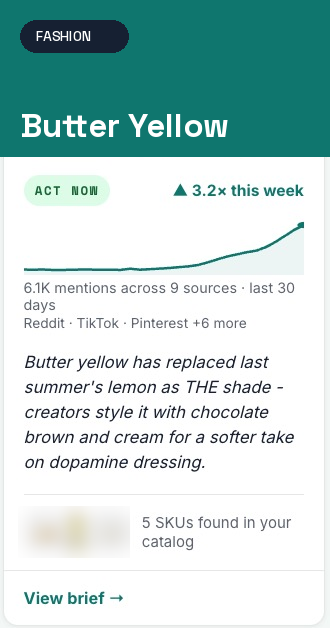
The second half of the piece is about the cost of that variety: staying coherent. Li warns the result is clutter. Lexy Martin, marketing director at With Nothing Underneath, sets the bar at "one brand world." Siedrés switched off Meta's AI image tools after catching them recolouring backgrounds, which is the trap in miniature: a recoloured background is exactly the variant retrieval has no use for.
Those are all defences mounted after the assets exist. Five ads cut from one movement start out related, so five different hands can make them and they still read as one world. The obvious objection is that a movement everyone can detect is one everyone acts on, and five brands shipping butter yellow the same week is clutter rather than coherence. The answer is in the brief: it names your products and the ones you hold depth in, so what ships is your version of the movement.
A movement is still a mood board until it names your products
I'd be overclaiming if I stopped there, because a movement alone doesn't fill a shot list. "Butter yellow is building in Germany" isn't a brief. It becomes one when it names the five products in your range that read as butter yellow, says which you hold depth in, and puts one of them behind each angle. That's a week of Meta creative on one page, and a producer can shoot it on Thursday.
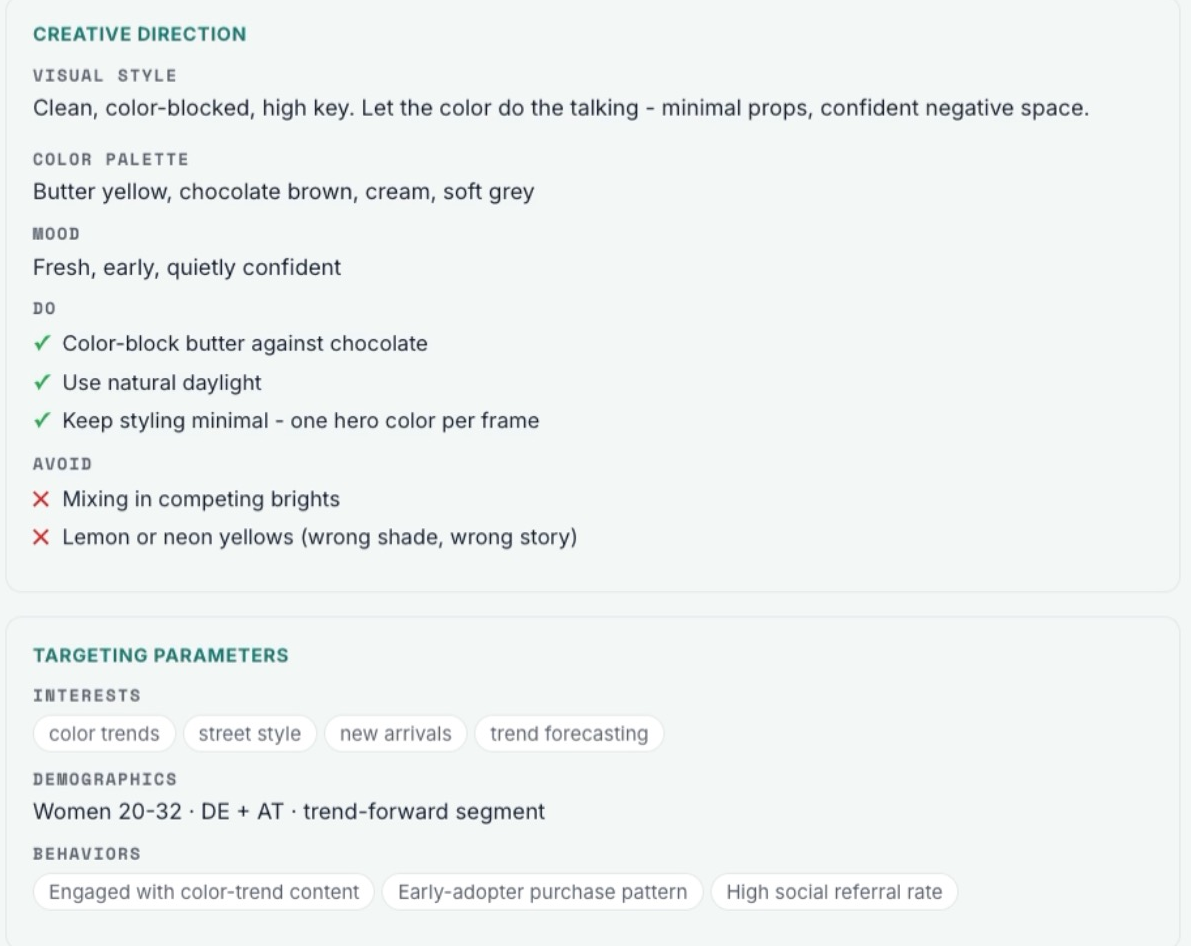
Getting from a movement to your SKUs is hard for a boring reason: trends are named in feeling words and products in attribute words, and the two vocabularies almost never share a term. I've written before about why that defeats keyword search and hand-picking, and about testing whether ours works. It's the least glamorous part of what we've built and the part I spend most of my time on.
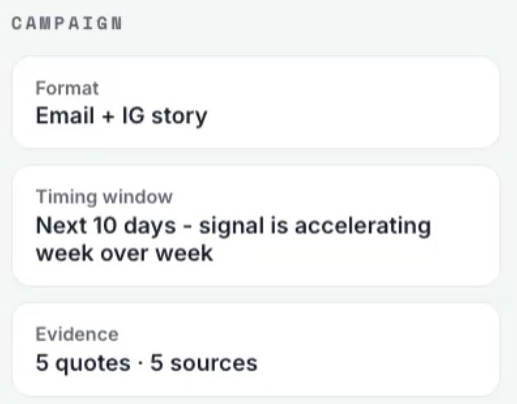
Today the briefs land with a person: a producer, a freelancer, an agency, a founder with a phone. The output is a shot list somebody shoots this week. We're working toward connecting them into the creative engines brands already use, which is why a brief carries the movement, the shopper, the angle and the products. That connection isn't built yet, and the brief doesn't need it.
One last thing, because it's the first question I'd ask of a post like this. All of it is an argument from the mechanism Poole described, not from a controlled test, and I can't hand you a lift number proving five reasons beat five recuts. What I'd stand behind is the division of labour. Retrieval decides who sees what and is very good at it. Deciding what is worth saying needs both what's happening in culture and what's in your warehouse, and Meta only has one of those.
If you want to see what a week of those briefs looks like against your own catalogue, that's what our demo is.
Quotes and reporting from Haley Crawford, "Why Fashion Brands Need More Instagram Ads Than Ever," The Business of Fashion, 6 August 2026 (BoF Professional).